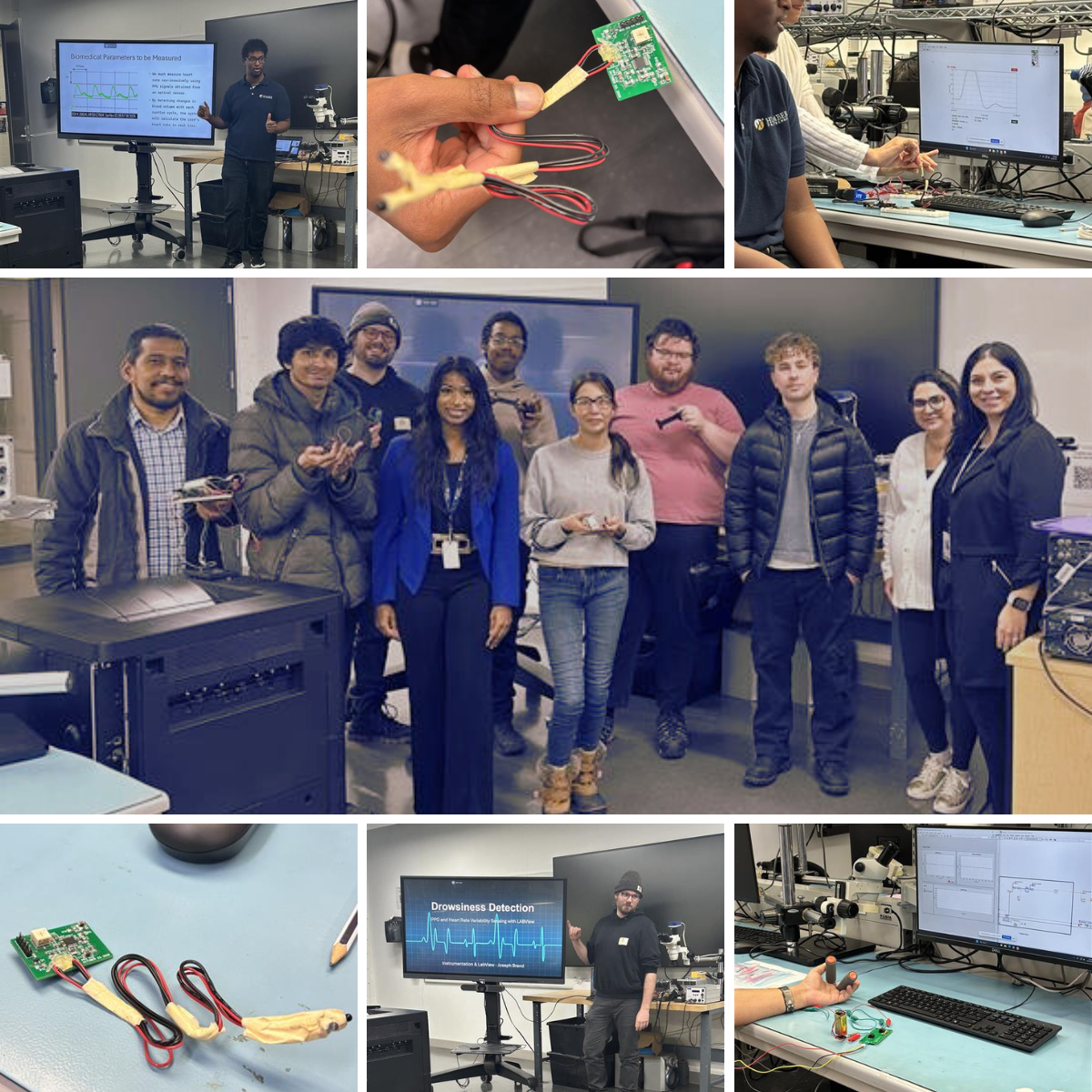
The Centre for Innovation in Health and Wellness (CIHW) recently collaborated on an experiential project with the Barrett Centre for Technology Innovation (Barrett CTI), the Faculty of Applied Sciences and Technology, and the Electronics Engineering Technology diploma program.
Students in their final year took on an ambitious challenge — designing and building functional medical device prototypes that are cost-effective and user-friendly. A research assistant student from the Bachelor of Workplace Health and Wellness program partnered directly with the engineering students, bringing healthcare user perspectives to the design process around usability, safety, client needs, and ergonomic considerations.
The results? Several impressive medical sensing system prototypes in the following areas:
- PPG Sensors for blood oxygenation measurement
- sEMG Sensor for muscle activation monitoring
- PPG + Heart Rate Variability Sensor for drowsiness detection
- Wearable Respiratory Sensor tracking breathing expansion and contraction
- PPG Monitor (Heart Rate + SpO2) using red and infrared light
- Heart Rate + Pulse Oximetry Monitor System for non-invasive cardiovascular and respiratory health
- HR + Pulse Oximetry Monitor
- Electromyography (EMG) Signal Acquisition for muscle movement activity
This project exemplified the power of experiential, interdisciplinary, and cross-faculty learning. Students didn't just build devices in a classroom - they engaged in authentic collaboration while working on real healthcare challenges. By bringing together healthcare knowledge and engineering expertise, students learned about both the design and human sides of medical technology.